Genres
Movie Overview & Analysis
Enemy at the Gates offers a tense look at the Battle of Stalingrad through the eyes of two snipers. While it showcases some strong performances and a dramatic setting, it occasionally loses its rhythm.
Decent but Not Groundbreaking
Enemy at the Gates offers engaging moments and strong performances but falters in its pacing and character depth. It's a decent watch for those interested in World War II narratives, though it doesn't fully capitalize on its potential.
Film DNA
The radar scores reflect a film that is solid in story depth and visual impact but struggles with emotional weight and rewatchability. It offers a fair amount of entertainment, though originality is somewhat lacking.
Pros
- Strong lead performances by Jude Law and Ed Harris
- Authentic wartime visuals enhance atmosphere
Cons
- Pacing issues with drawn-out sequences
- Supporting characters lack depth and development
For War Enthusiasts Only
This film will appeal to history buffs and war film enthusiasts who appreciate the psychological aspects of combat. However, viewers who prefer fast-paced narratives or light-hearted entertainment may find it tedious and overly somber. Fans of character-driven dramas might enjoy the personal conflicts, though some may feel disappointed by character development that doesn't fully explore the complexities of its leads. It's not for everyone; those looking for straightforward action might want to skip it.
Snipers in Stalingrad
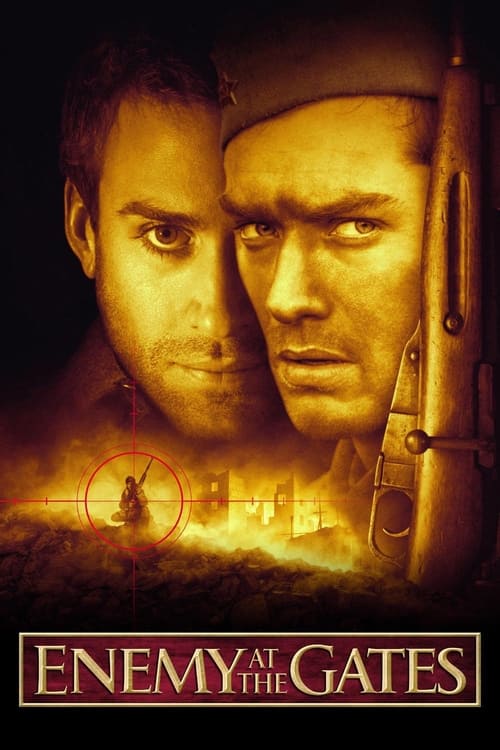
Set during World War II, Enemy at the Gates follows the intense rivalry between Russian sniper Vassili Zaitsev (Jude Law) and his German counterpart Major König (Ed Harris). As the Siege of Stalingrad rages on, Vassili is heralded as a national hero, prompting a fierce cat-and-mouse game between the two marksmen. The film interweaves personal relationships, including Vassili's romance with Tania Chernova (Rachel Weisz), while exploring themes of survival and heroism amidst the brutal realities of war. However, its pacing occasionally stumbles, making some sequences feel dragged out and repetitive.
Strong Leads, Mixed Support
Jude Law delivers a solid performance as Vassili, capturing the internal struggle of a reluctant hero. Ed Harris as Major König provides a chilling antagonist, though he could have benefited from deeper development to elevate the tension. Rachel Weisz is charming, but her character often feels underutilized, serving mainly as a plot device. The supporting cast, including Joseph Fiennes as Commisar Danilov, does well but occasionally falls into cliché. Overall, while the main characters are engaging enough, the film sometimes shifts focus too much, leaving some arcs feeling half-formed.
Gritty Yet Uneven Visuals
Jean-Jacques Annaud's direction brings a raw authenticity to the film, aided by the gritty cinematography that captures the bleakness of war. The visual choices, especially in battle sequences, effectively convey chaos but sometimes lack clarity, making it hard to follow the action. The pacing also suffers, with slower moments that could have been trimmed for impact. Nevertheless, the film's atmospheric score and production design create a palpable sense of time and place, which serves to draw viewers into the harrowing environment of Stalingrad.
Tension with Slow Moments
Watching Enemy at the Gates can feel like a mixed bag; moments of tension are often interrupted by drawn-out sequences that may test a viewer's patience. While the film attempts to evoke a sense of camaraderie and sacrifice, the emotional beats don't always land as intended. There are scenes that should elicit strong feelings but instead feel predictable or overdone. Still, there are sparks of intensity, particularly in the sniping duels, that create an engaging experience for those willing to endure the slower moments of storytelling.
Watch if you liked: Saving Private Ryan, Enemy Lines
No comments yet. Be the first to share your thoughts!