Genres
Movie Overview & Analysis
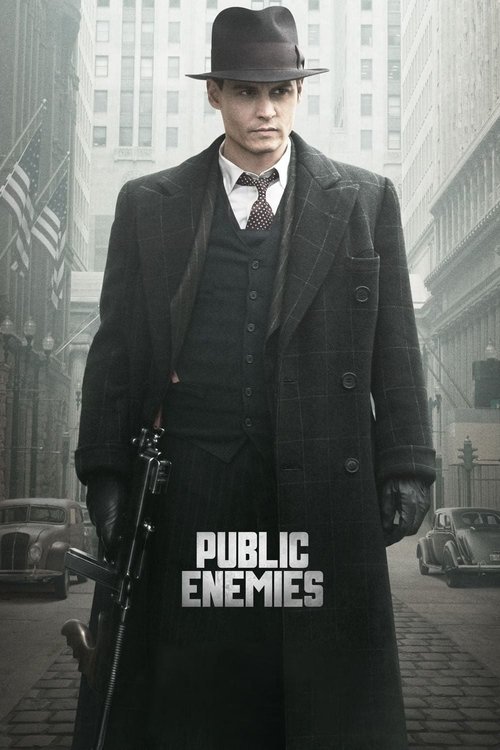
Michael Mann's 'Public Enemies' captures the allure of bank robber John Dillinger against the backdrop of the Great Depression. However, it struggles to maintain a gripping narrative amidst its bloated runtime.
Close, But Not Quite
'Public Enemies' has its moments, particularly in its performances and visual style, but it ultimately falls prey to pacing issues and narrative excess. There's enough intrigue to keep you engaged, but you're likely to find yourself checking the runtime more than once.
Film DNA
The radar scores suggest that while 'Public Enemies' offers solid visuals and some engaging moments, it struggles with emotional depth and rewatchability due to its uneven storytelling.
Pros
- Strong performances by Depp and Bale
- Visually striking cinematography
Cons
- Slow pacing in parts
- Underdeveloped supporting characters
For Crime Drama Enthusiasts
'Public Enemies' caters to those with a taste for crime dramas and historical narratives, especially viewers interested in the American gangster era. Fans of Michael Mann’s previous works may find some redeemable qualities here, particularly in the cinematography and action sequences. However, viewers who prefer tightly woven plots or character-driven stories may find themselves frustrated by the film's pacing and occasional lack of focus. Those looking for fast-paced entertainment or a straightforward narrative will likely be left wanting more, as the film’s ambition sometimes overshadows its execution.
Dillinger's Rise and Fall
'Public Enemies' chronicles the audacious escapades of notorious bank robber John Dillinger, played by Johnny Depp, who becomes a symbol of resistance for the disenchanted public during the Great Depression. As he draws the ire of J. Edgar Hoover and the FBI, agent Melvin Purvis, portrayed by Christian Bale, is determined to bring Dillinger to justice. The film vacillates between thrilling heists and tense cat-and-mouse games, with Dillinger's romance with Billie Frechette (Marion Cotillard) serving as both a plot driver and emotional anchor. Unfortunately, the sprawling narrative sometimes loses focus, with various subplots feeling underdeveloped or excessive, which detracts from its overall impact.
Performances with Missed Opportunities
Johnny Depp leads the ensemble with his charismatic portrayal of John Dillinger, effectively embodying the rogue appeal of the infamous criminal. Christian Bale's performance as Melvin Purvis is competent but lacks the depth and complexity needed to elevate the character beyond a simple antagonist. Marion Cotillard brings warmth to Billie Frechette but is often sidelined, serving primarily as a romantic interest. Other supporting characters, like Billy Crudup's J. Edgar Hoover and Jason Clarke’s Red Hamilton, are underutilized, leaving crucial dynamics unexplored. There are moments where the cast shines, but the uneven character development hampers their potential impact.
Gritty Realism, Uneven Pacing
Michael Mann's direction in 'Public Enemies' features a gritty realism, using a muted color palette and a mix of handheld camera work to enhance the film's tense atmosphere. The action sequences, including the well-choreographed bank heists, are engaging and capture the chaotic essence of the time. However, the pacing suffers greatly; the film exceeds two hours yet drags in sections where it could have tightened its focus. The editing often feels disjointed, leading to a lack of narrative cohesion that detracts from the visual storytelling Mann aims for. While visually striking in moments, the overall execution could benefit from more streamlined storytelling.
Tension That Comes and Goes
Watching 'Public Enemies' is a mixed bag; it oscillates between thrilling heist scenes and stretches where the narrative stalls. While some moments possess genuine tension, the film's length often leads to boredom, especially in parts filled with excessive dialogue or unnecessary exposition. The emotional stakes feel uneven, making it hard to connect deeply with the characters or their plights. Dillinger’s charm initially hooks the audience, but as the story progresses, the sense of urgency dissipates. The film's uneven pacing ultimately dilutes the emotional weight it tries to convey, leaving viewers less invested in its resolution.
Watch if you liked: The Godfather, Heat
No comments yet. Be the first to share your thoughts!